
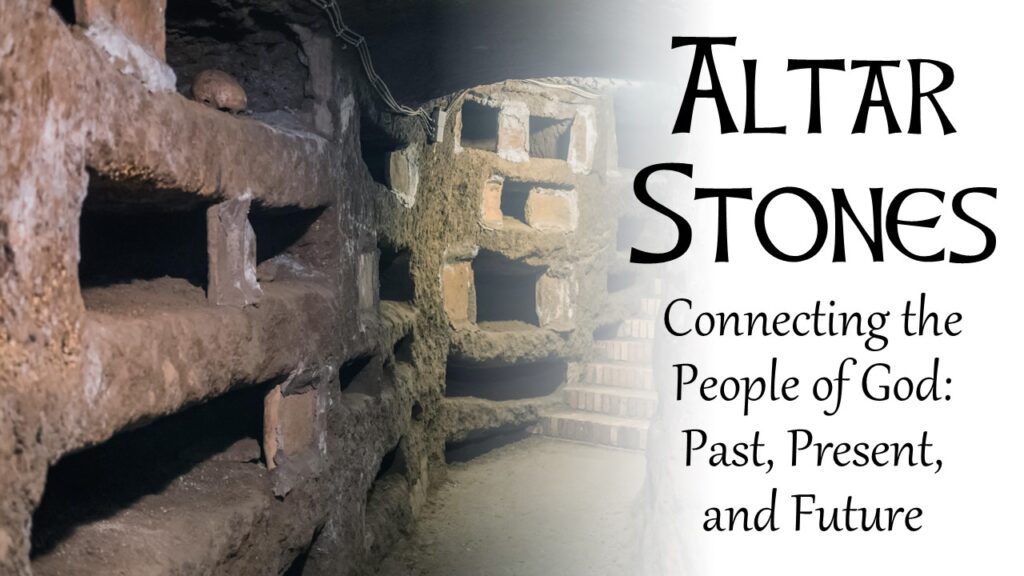
Many Catholics may have heard the term altar stone but are unsure what it is. Altar stones carry a beautiful history that connects us directly to the earliest Christians and to the very foundations of our faith. In the first centuries of Christianity, during the Roman persecutions of Christians, the faithful gathered in secret to celebrate the Eucharist. One of the most sacred places for these celebrations was the underground Catacombs of Rome, where Christian martyrs were buried.
As the Church emerged from persecution with the Edict of Milan in 325, churches were built with permanent altars. To continue the tradition of celebrating Mass at the graves of the martyrs, it became customary to place relics of saints within the altar itself. [Over time, this led to the use of altar stones.] These small, consecrated slabs of natural stone containing relics were inserted into the mensa (table top) of the altar. Altar stones were also used when Mass was celebrated outside a consecrated church. Missionary priests and chaplains in times of war would carry altar stones so that wherever the Eucharist was offered, it remained firmly rooted in the tradition of the Church. Following the Council of Trent (1545-1563), the use of altar stones became standard practice. Every altar either had to be consecrated or contain a consecrated altar stone with relics. In this way, every Mass was visibly connected to Christ, the “cornerstone,” and to the saints who built up the Church through their faith.
After the Second Vatican Council, the Church simplified these requirements. While altar stones are no longer always necessary, the tradition of placing relics within permanent altars continues, reminding us that our faith is built upon the witness of those who have gone before us. Altar stones point to a profound truth: every Mass unites heaven and earth. We stand not alone, but in communion with the saints, gathered around the sacrifice of Christ.
Does Good Shepherd have an altar stone?
The altar of our original church on Market Street had an altar stone with the relics of the martyrs Saint Fulgentius and Saint Costus. By 1978, liturgical law did not require an altar stone in the mensa (table top) and directed that, if relics were to be included, they were placed in the base of the altar itself. So the altar stone (with relics) from Market Street was placed in the right-hand support of our current altar on Tridle Road. The historical altar we acquired from Saint Charles Borromeo Seminary in the Archdiocese of Philadelphia was constructed with its own altar stone. The relics were removed before our acquisition. This is the stone that Pope Leo blessed in Rome on February 4, 2026. The stone will be returned to the mensa of the new altar when it is installed this summer. The altar stone from Market Street which is incorporated into our current altar, will be placed in the base of our new altar.
Who were Saint Fulgentius and Saint Costus?
There are known saints named Fulgentius and Costus, but they were not martyrs. However, the documentation we have certifies that our Saint Fulgentius and Saint Costus were martyrs. Many martyrs of the Early Church were known only by names that appear on tombs in the ancient Christian Catacombs or on burial lists. Over centuries, the Church carefully safeguarded its relics, even when details of their lives were lost. When altar stones were prepared, like ours in 1951, relics were often drawn from these ancient Roman sources. So our altar stone connects directly back to the early centuries of Christianity.
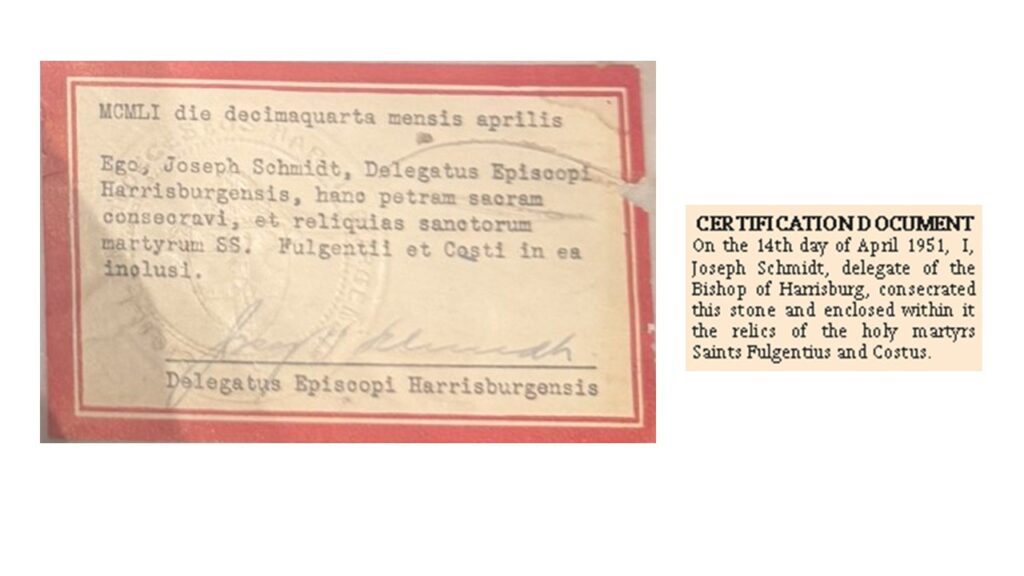
We do not know their stories. We do not know where they lived, how they died, or what their final words were. All we have are their names, preserved through the centuries, sealed into stone, hidden beneath the altar. Yet, that is enough. Fulgentius and Costus remind us of something we often forget. Holiness is not about being remembered. It is about being faithful. But these saints whisper to us that God remembers. God remembers every quiet act of love. Every hidden sacrifice. Every moment of fidelity when no one else sees. Every time the Eucharist is celebrated on our altar, it is as if the Church is saying that these lives mattered. Their witness endures. Their hidden holiness still supports the Church today. They invite us to live with quiet courage, to be faithful in the ordinary, to trust that even if our names are forgotten by history, they are never forgotten by God. And in the end, that is enough.